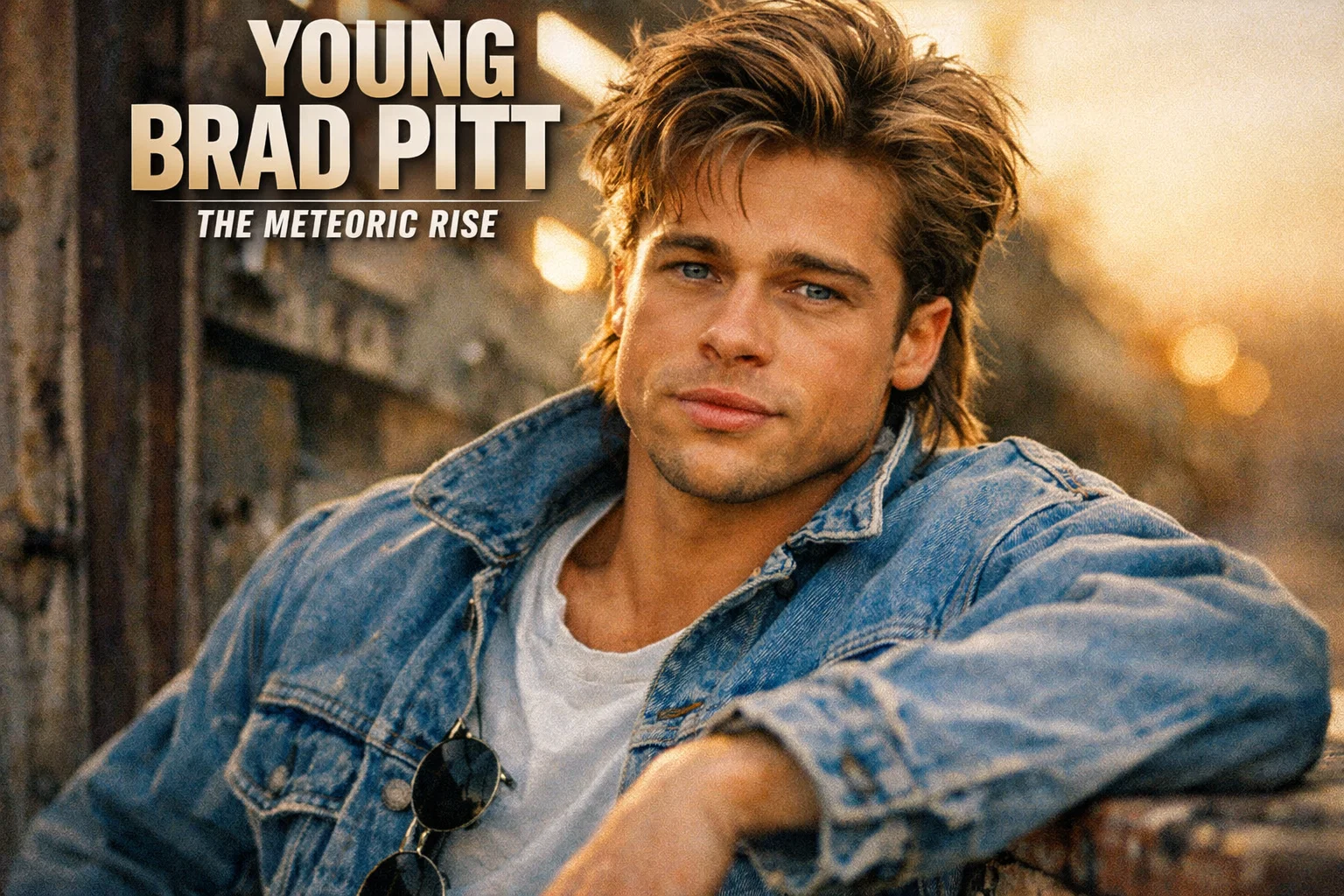
To talk about Brad Pitt is to talk about modern Hollywood royalty—an actor, producer, and enduring icon whose career spans decades of critical and commercial evolution. But to truly understand the phenomenon, one must journey back to the beginning, to the raw, magnetic, and undeniably potent era of a young Brad Pitt. This wasn’t merely the start of a career; it was the ignition of a cultural force. Before the Oscar-winning prestige, the prolific production company, and the status as a grizzled character actor, there was a golden-haired young man from Missouri whose astonishing looks and surprising depth captured the global imagination almost overnight.
The story of young Brad Pitt is a blueprint for cinematic stardom in the late 20th century, a fascinating study of how sheer charisma, carefully chosen risks, and an inherent understanding of the camera can forge a legend. It’s a tale of transition, from being labeled a mere “heartthrob” to being recognized as a serious, formidable actor, all while navigating the blinding glare of the spotlight. This article delves deep into those formative years, exploring the roles, the persona, and the pivotal moments that transformed an aspiring actor into one of the most defining faces of his generation.
The Formative Years: From Missouri to Hollywood Dreams
Long before the red carpets and the screaming fans, William Bradley Pitt was a young man with a plan, albeit one that took a detour. Born in Shawnee, Oklahoma, and raised in Springfield, Missouri, Pitt’s early life pointed toward a more conventional path. He enrolled at the University of Missouri to study journalism, with a focus on advertising. However, just two credits shy of graduation, he was seized by a restless ambition.
The world of film, which he had only experienced as a spectator, called to him. With a leap of faith that has since become Hollywood lore, the young Brad Pitt packed his belongings—reportedly with only $325 in his pocket—into his Datsun and drove to Los Angeles. He wasn’t an instant success. Like countless others, he faced the grinding reality of audition rejections, odd jobs, and the constant hustle for a breakthrough.
He took acting lessons, honing his craft, and survived by driving strippers in a limousine, moving refrigerators, and even dressing as a giant chicken for the restaurant chain El Pollo Loco. These weren’t glamorous years, but they were essential. They grounded the future star and provided the grit behind the soon-to-be-discovered glamour. His first on-screen appearances were uncredited bits and pieces in films like Less Than Zero and a solitary line on the television show Dallas. These tiny roles were the necessary dues paid, the anonymous steps taken by a young Brad Pitt learning the mechanics of a set and the language of the industry. It was a period of incubation, where the raw materials of his future persona were being assembled, unseen by the wider world.
The Heartthrob Ignition: Thelma & Louise and the Role That Changed Everything
The year was 1991. Ridley Scott’s feminist road movie Thelma & Louise was about to become a cultural landmark, but one of its most lasting legacies would be the introduction of a global superstar. Cast as J.D., a charming, seductive, and ultimately treacherous drifter, the young Brad Pitt exploded onto the screen with barely twenty minutes of screen time.
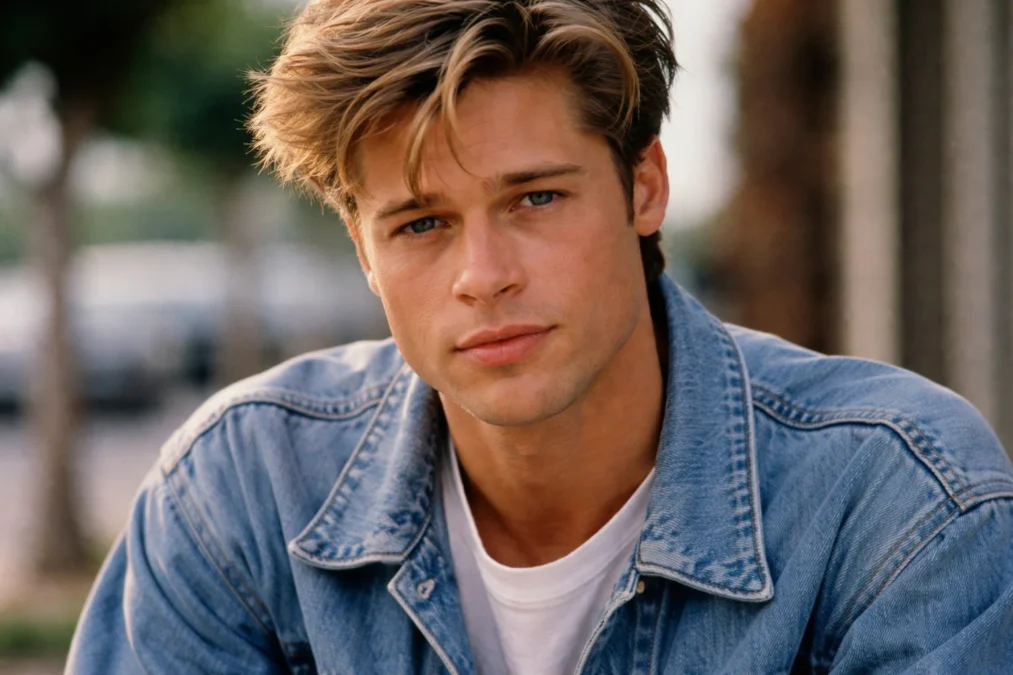
Yet, his impact was seismic. With his tousled blonde hair, a confident, easy smile, and a shirtless scene that quickly entered the cinematic lexicon, Pitt didn’t just play a character; he delivered a full-scale archetype of youthful, rustic allure. His performance was nuanced—a blend of genuine, boyish charm and underlying shiftiness that made him impossible to look away from.
The film’s success catapulted him from a complete unknown to a household name overnight. He was no longer just another aspiring actor; he was the new face, the subject of magazine covers, and the obsession of a growing fan base. The role of J.D. typecast him immediately as a heartthrob, a label that would bring immense fame but also become a creative cage he would spend years trying to escape. Nonetheless, this moment was the undeniable catalyst. It proved that the young Brad Pitt possessed that elusive, electric “it” factor—a camera presence that translated into instant audience connection. Hollywood took immediate note, and the floodgates for leading man roles swung wide open, forever altering the trajectory of his life and career.
Navigating Leading Man Status: Early Successes and Experiments
In the immediate wake of Thelma & Louise, Hollywood was eager to capitalize on this new golden boy. The young Brad Pitt was thrust into a series of high-profile leading roles that tested his range and box-office draw. He first leaned into his romantic appeal with Johnny Suede (1991), a quirky indie that showcased his comedic timing and physicality.
Then came Cool World (1992), a bizarre live-action/animation hybrid that, while a critical misfire, demonstrated his willingness to take bizarre creative risks early on. But it was A River Runs Through It (1992), directed by Robert Redford, that provided a crucial pivot. As the rebellious, charismatic Paul Maclean, Pitt delivered a soulful, nature-bound performance that hinted at the dramatic depth beneath the dazzling exterior. Redford’s direction helped channel Pitt’s raw energy into something more poetic and substantial.
This period was a mixed bag of commercial ventures and artistic striving. He starred in the gritty Kalifornia (1993), playing against type as the violent, unhinged Early Grayce, complete with a grungy aesthetic that deliberately marred his looks. It was a clear statement of intent—a desire to be taken seriously as an actor, not just a pin-up. Then came Interview with the Vampire (1994), where his casting as the brooding, immortal Louis de Pointe du Lac opposite Tom Cruise’s Lestat was met with fan uproar but ultimately resulted in a performance of profound melancholy and torment. Through these varied roles, the young Brad Pitt was actively mapping his territory, testing his limits, and slowly, deliberately, complicating the simple heartthrob narrative that had launched him.
The Pinnacle of Young Stardom: Legends of the Fall and Seven
By the mid-1990s, the young Brad Pitt had evolved from a surprise breakout into a bona fide A-list leading man. Two films released in close succession cemented this status and showcased the two dominant poles of his early appeal: the epic romantic hero and the modern, intense protagonist. First, in 1994’s Legends of the Fall, Pitt gave a career-defining performance as Tristan Ludlow. In the sweeping landscapes of early 20th-century Montana, Pitt was pure, untamed emotion—a character of fierce love, profound grief, and wild impulsiveness.
His chemistry with the environment and the camera was palpable. The role leaned into his physical beauty but demanded a raw, animalistic emotional range that he delivered powerfully. The film was a massive hit, and Pitt’s portrayal became the very image of the tragic, romantic hero for a generation.
Then, in 1995, he pivoted sharply to the urban darkness of David Fincher’s Seven. As Detective David Mills, the eager, hot-headed rookie opposite Morgan Freeman’s weary Somerset, Pitt found a perfect vehicle for a different kind of intensity. The film’s grim, rain-soaked aesthetic and horrific plot provided a stark contrast to the sun-drenched plains of Legends. Here, Pitt’s youth and idealism were systematically broken down, culminating in one of the most shocking and memorable climaxes in cinematic history. His final, gut-wrenching cry of “What’s in the box?!” is a masterclass in raw, horrified realization.
Seven was a critical and commercial smash, proving that the young Brad Pitt could anchor a serious, sophisticated thriller and hold his own with revered actors. It also began his long and fruitful creative partnership with David Fincher, a director who would continually push him to new heights.
The Cult Icon Emerges: Fight Club and Cementing a Legacy
If Seven demonstrated Pitt’s serious acting chops, 1999’s Fight Club immortalized him as a counterculture icon. His portrayal of Tyler Durden is arguably the zenith of his early career—a role that synthesized his physical prowess, charismatic menace, and subversive intelligence into a singular, explosive package. Directed, again, by David Fincher and based on Chuck Palahniuk’s novel, the film was a brutal, philosophical critique of consumerism and emasculated modern life. As Tyler, Pitt was the id unleashed: shirtless, sinewy, and spouting anarchic mantras that resonated deeply with a disaffected generation. He was magnetic, terrifying, and darkly funny, creating a character that transcended the film to become a symbol of rebellion.
The film’s initial box office was subdued, and reviews were polarized, but its VHS and DVD release sparked a cultural wildfire. Young Brad Pitt as Tyler Durden became a poster on dorm rooms worldwide, his quotes recited like scripture. The performance was a deliberate deconstruction of his own movie-star image—a critique of the very allure that had made him famous. It showcased his fearlessness in embracing unlikeable, complex, and ideologically charged characters.
Fight Club completed a remarkable decade-long arc. It proved that the young Brad Pitt was not just a movie star who could act, but a daring artist willing to use his fame as a tool for provocative, challenging work. It was the final, definitive statement of his young adulthood as an actor, closing the chapter on the 1990s with a snarling, unforgettable bang.
The Evolution of Style and Persona
Parallel to his on-screen evolution was the development of Brad Pitt’s off-screen persona and iconic style. The young Brad Pitt became as much a fixture in fashion spreads as in film magazines. His look evolved organically with his roles, creating a feedback loop between character and celebrity.
The rugged, flannel-shirted handsomeness of Legends of the Fall influenced a wave of “frontier chic.” The sleek, minimalist, and slightly disheveled look of Seven and Fight Club—think tailored suits with undone ties, or red leather jackets—became a blueprint for urban cool. Pitt, often resisting formal fashion dictates, embodied a kind of effortless, masculine style that felt both attainable and aspirational.
His public persona was a careful balance. He granted interviews but was famously private about his personal life, a trait that only intensified public fascination. He was portrayed as the laid-back, thoughtful artist—a sharp contrast to the wild party boy image of some contemporaries. He spoke thoughtfully about architecture, art, and his craft.
This cultivated an aura of depth, suggesting the heartthrob was, in fact, a serious man with serious interests. The media narrative around the young Brad Pitt was a dance between his undeniable sex symbol status and his clear desire to be seen as more than that. He managed this difficult transition with a savvy understanding of image, allowing his daring role choices to do most of the talking while maintaining an enigmatic, cool distance in the public eye.
Critical Reception and the Struggle for Respect
The journey of the young Brad Pitt was not without its critical speed bumps. For every accolade he received for his depth in A River Runs Through It or intensity in Seven, there was a critic ready to dismiss him as a pretty face coasting on looks. Early reviews often focused more on his appearance than his performance. This frustration was palpable for Pitt, who actively sought complex, messy, and even ugly roles to break the mold. Films like Kalifornia and 12 Monkeys (for which he received his first Academy Award nomination for Best Supporting Actor) were direct assaults on his heartthrob image.
The industry itself was also learning how to categorize him. He wasn’t a traditional action hero like Stallone or Schwarzenegger, nor was he a purely dramatic actor like his contemporary Sean Penn. He occupied a unique space—a marquee idol with indie sensibilities. This duality sometimes led to uneven projects, but ultimately became his strength. By the end of the 1990s, through persistent, careful work and collaborations with auteurs like Fincher, Terry Gilliam (12 Monkeys), and later, Guy Ritchie (Snatch), he had largely won the critical battle.
The narrative shifted from “can he act?” to an appreciation of his specific talents: his magnetic screen presence, his commitment to physicality, and his intelligent choice of collaborators. The young Brad Pitt had successfully reframed himself as a credible and powerful actor, paving the way for the prolific producer and award-winning lead he would become in the 21st century.
The Lasting Influence of Young Brad Pitt
The impact of young Brad Pitt on Hollywood and popular culture is immeasurable. He defined a specific era of leading man—one that blended traditional movie-star glamour with a Generation X sensibility of irony, dissatisfaction, and cool. He proved that massive commercial success and artistic ambition were not mutually exclusive.
The blueprint he followed—using a flash of sex appeal to gain entry, then systematically challenging that very image—has been studied and emulated by actors ever since. His specific looks in films like Thelma & Louise and Fight Club are permanently etched in the visual history of cinema, constantly referenced in fashion, photography, and other media.
Moreover, his career choices encouraged a generation of actors to seek out auteur directors and complex material. He helped normalize the idea of a movie star also being a character actor, willing to disappear into roles. The legacy of the young Brad Pitt is not just a catalogue of famous films; it’s a testament to strategic, intelligent career management in the face of overwhelming fame.
He showed that it was possible to control the narrative, to evolve, and to use one’s platform for interesting, sometimes risky, art. The foundation he built in that first explosive decade allowed him to become the versatile producer and Oscar-winning actor he is today, but it’s the thrilling, unpredictable journey of his youth that continues to captivate audiences old and new.
Filmography Table: The Defining Young Brad Pitt Era (1991-1999)
| Year | Film Title | Role | Significance |
|---|---|---|---|
| 1991 | Thelma & Louise | J.D. | Breakout role; defined the heartthrob archetype. |
| 1991 | Johnny Suede | Johnny Suede | Early leading role showcasing quirky, comedic charm. |
| 1992 | A River Runs Through It | Paul Maclean | Demonstrated dramatic depth and soulful magnetism. |
| 1993 | Kalifornia | Early Grayce | Deliberate against-type role as a violent drifter. |
| 1994 | Interview with the Vampire | Louis de Pointe du Lac | High-profile role showcasing torment and melancholy. |
| 1994 | Legends of the Fall | Tristan Ludlow | Epic romantic hero; cemented leading man status. |
| 1995 | Seven | Detective David Mills | Critical smash; proved chops in dark, serious thriller. |
| 1995 | 12 Monkeys | Jeffrey Goines | First Oscar nomination; showcased manic, eccentric energy. |
| 1999 | Fight Club | Tyler Durden | Counterculture icon; deconstructed his own star image. |
Quotes on Young Brad Pitt
- “He walked in, and I thought, ‘Oh my god, he’s so beautiful.’ And then he started to read, and he was so shy and unformed, but you could see the talent shining through.” – Geena Davis, on Pitt’s audition for Thelma & Louise.
- “Brad has this ability to be both completely present and utterly mysterious. In Legends of the Fall, he’s all emotion, right on the surface, but you feel there are depths he’s not showing you. That’s star power.” – A film critic on Pitt’s early appeal.
- “Working with Brad on Fight Club, it was clear he wasn’t interested in being safe or liked. He wanted to attack the role of Tyler, to find the ugliness and the charm and make them inseparable. He was building an icon, knowingly.” – David Fincher, director.
- “We all saw the magazine covers. But in 12 Monkeys, he made you forget all that. He created this twitchy, heartbreaking character. That’s when I think the industry truly saw he was a craftsman.” – Terry Gilliam, director.
Conclusion
The story of a young Brad Pitt is the story of modern stardom being written in real time. It was a dazzling, sometimes turbulent, and always fascinating ascent from complete unknown to one of the most recognizable faces on the planet. More than just a series of famous movies, it was a masterclass in navigating the treacherous waters of instant fame. Pitt deftly used his almost overwhelming physical allure as a key to open doors, then promptly set about proving he belonged in the room for far more substantive reasons.
From the sun-bleached charm of J.D. to the philosophical rage of Tyler Durden, each role was a stepping stone, a statement, or a rebellion. He didn’t just accept the title of leading man; he redefined it for a new era, blending traditional heroism with complexity, vulnerability, and a sharp edge of danger. The legacy of the young Brad Pitt endures because it represents a perfect convergence of time, talent, and image—a moment when an actor’s journey became inseparable from the cultural zeitgeist. The foundation laid in those formative years didn’t just create a movie star; it forged an enduring artist whose influence continues to resonate.
Frequently Asked Questions
What was Brad Pitt’s first major film role?
While he had small, uncredited parts before, the undisputed first major film role for a young Brad Pitt was as J.D., the charming drifter in Ridley Scott’s 1991 film Thelma & Louise. Though his screen time was relatively brief, his performance was so magnetic and impactful that it instantly made him a star and defined the “heartthrob” label that would follow him for years.
How did Brad Pitt break away from being just a “heartthrob”?
The young Brad Pitt actively and strategically chose roles that complicated his pretty-boy image. He played a violent, unhinged killer in Kalifornia (1993), a tormented vampire in Interview with the Vampire (1994), and a mentally unstable activist in 12 Monkeys (1995), which earned him his first Oscar nomination. These choices, often involving physical transformation or embracing unlikable traits, forced critics and audiences to see his dedication to craft over his looks.
What is considered Brad Pitt’s breakout role in the 1990s?
While Thelma & Louise (1991) was his introduction, the true breakout role that cemented him as a dramatic leading man was Tristan Ludlow in Legends of the Fall (1994). This performance showcased his ability to carry a sweeping epic and convey deep, raw emotion, proving he was more than a flash-in-the-pan heartthrob and could anchor a major Hollywood film.
Which director had a major impact on young Brad Pitt’s career?
Director David Fincher had a profound impact on the career of the young Brad Pitt. Their collaboration began with the critical and commercial hit Seven (1995), which showcased Pitt’s intensity in a serious thriller. They then created the cultural landmark Fight Club (1999), a role that allowed Pitt to deconstruct his own star image and become an enduring counterculture icon, cementing his status as a fearless and insightful actor.
How did Brad Pitt’s style evolve during his early years?
The style of the young Brad Pitt evolved in tandem with his roles, creating iconic looks for each era. It moved from the rugged, flannel-and-denim frontier chic of A River Runs Through It and Legends of the Fall, to the sleek, dark urban detective wear in Seven, culminating in the anarchic, red-leather-jacket and fight-shorts aesthetic of Fight Club. His off-duty style mirrored this—effortless, slightly disheveled, and deeply influential in defining 1990s masculine cool.