
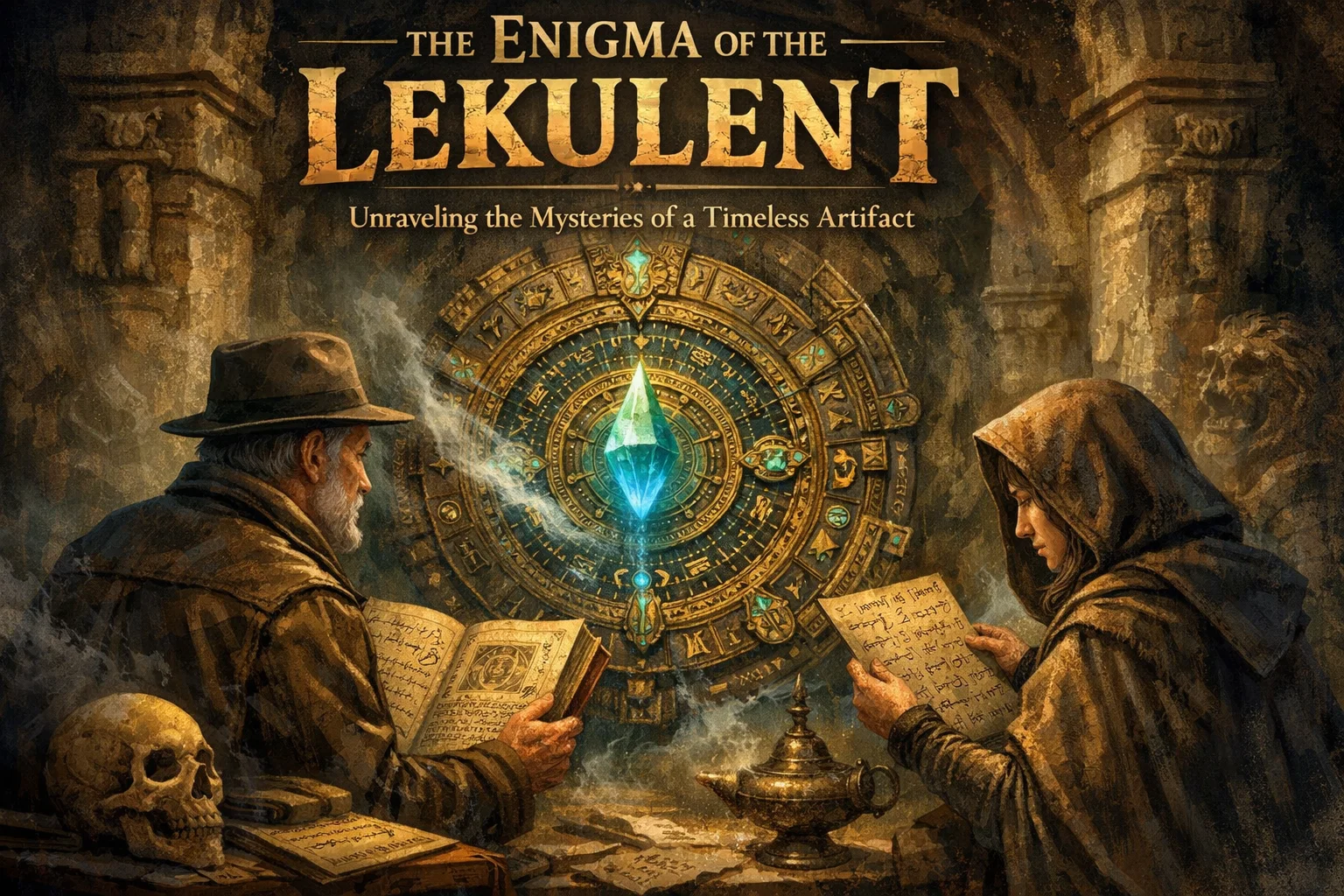
Lekulent In a world saturated with digital marvels and fleeting trends, there exists a category of objects that defy simple explanation, weaving together threads of ancient history, speculative metaphysics, and contemporary fascination. Among these enigmatic items, one name surfaces with a particular aura of mystery: the Lekulent. To the uninitiated, the term might sound like a forgotten mineral, a piece of obscure folklore, or perhaps a conceptual tool from a fantasy novel.
Yet, for those who have delved into its lore, the Lekulent represents far more—it is a nexus of stories, a supposed key to hidden knowledge, and a physical (or sometimes metaphysical) object of profound curiosity. This article is a journey into the heart of that mystery. We will explore the tangled roots of the Lekulent, examine the myriad theories about its nature and purpose, trace its influence through culture and media, and ponder why, in our age of information, such artifacts continue to captivate the human imagination. Whether you are a skeptic, a seeker, or simply intrigued by the unexplained, the story of the Lekulent offers a compelling tapestry of human wonder.
Origins and Historical Traces of the Lekulent
The quest to understand the Lekulent inevitably begins with a frustrating yet tantalizing problem: its origins are obscured by time and layered with contradictory accounts. There is no single, agreed-upon point of creation or discovery, which only adds to its mystique. Some of the earliest whispers in esoteric circles suggest the Lekulent may have its roots in pre-Christian Eurasian traditions, perhaps as a ritual object used by shamans or druids to focus spiritual energy or interpret natural omens. These versions often describe it as a smooth, naturally occurring stone, sometimes veined with peculiar minerals, that was revered for its perceived connection to the earth’s ley lines or celestial cycles.
Other historical fragments, often cited in alternative archaeology texts, link the Lekulent to the library of Alexandria, suggesting it was a device of ancient knowledge-keeping—a crystalline or metallic form that could, in theory, store information in ways lost to modern science. Alchemical manuscripts from the Middle Ages, albeit never directly naming the “Lekulent,” sometimes refer to a Lapis Specularis or “seeing stone” with properties that eerily match later descriptions of the artifact: an object that could reveal truths, amplify intention, or serve as a conduit for visionary experiences. The lack of a clear, linear history is not a bug in the story of the Lekulent; it is its defining feature. Each era and culture it supposedly touched seems to have projected its own needs and understandings onto the object, reshaping its legend while preserving its core identity as a thing of power and mystery.
This historical ambiguity has made the Lekulent a favorite subject for researchers operating outside mainstream academia. They pore over coded texts, analyze alleged carvings on forgotten monuments, and cross-reference mythologies from disparate cultures, searching for the common thread that might prove the artifact’s physical reality and ancient pedigree. The debate is perpetual: is the Lekulent a single, lost physical object? A class of objects with similar properties? Or is it purely a memetic entity—an idea so powerful it has taken on a life of its own in the collective unconscious? This foundational uncertainty fuels all subsequent exploration, making every theory about the Lekulent’s power a reflection of the theorist as much as the object itself.
The Nature and Purported Powers of the Artifact
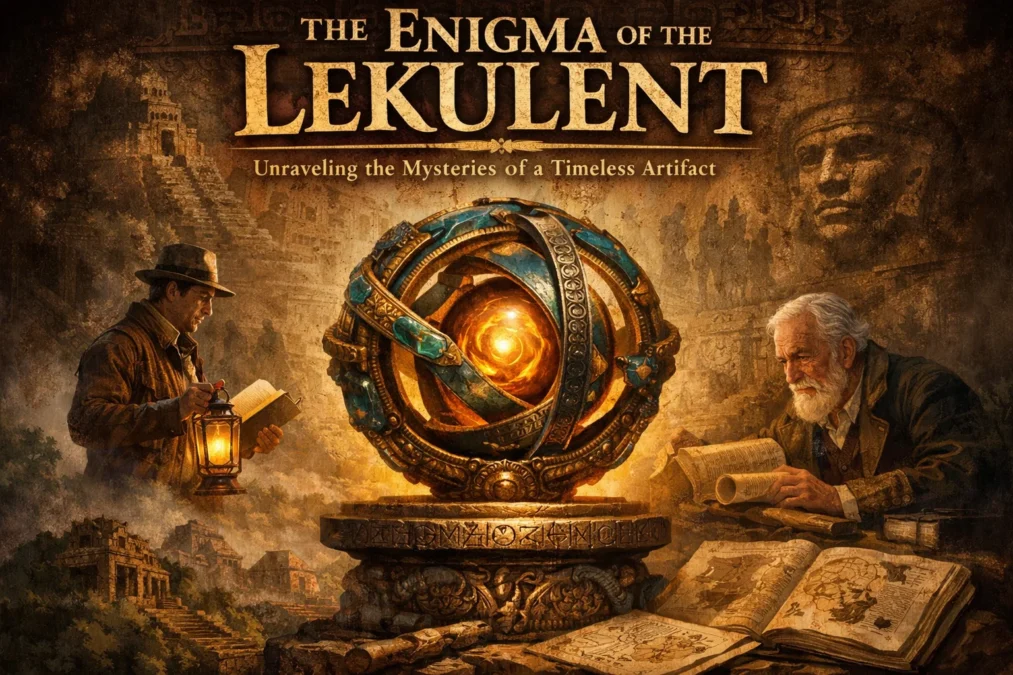
If the history of the Lekulent is murky, the descriptions of its form and abilities are a kaleidoscope of possibilities. There is no standard-issue Lekulent. In some accounts, it is depicted as a polished, ovular stone, cool to the touch, with a complex internal lattice that seems to catch the light in impossible ways. In others, it is a crafted piece, perhaps metallic, inscribed with symbols from no known language, fitting perfectly in the palm. Modern interpretations sometimes even frame it as a quasi-technological device, suggesting an appearance akin to a polished obsidian tablet or a geometrically perfect crystal of unknown composition.
The purported powers of the Lekulent are where the legend truly expands. Commonly, it is described as an amplifier of consciousness. Users—often called “resonators” or “operators” in contemporary circles—report that focused meditation with the Lekulent can lead to heightened states of awareness, vivid lucid dreaming, or a sharpening of intuitive faculties. This has led to its association with divinatory practices, though proponents argue it is less about telling the future and more about clarifying the present and one’s path within it. Another persistent claim is that the Lekulent can act as an energetic stabilizer, harmonizing the environment or the individual’s personal bio-field, a concept that bridges ancient ideas of vital energy with modern biohacking.
Perhaps the most fascinating and controversial ability attributed to the Lekulent is its supposed function as an interdimensional or temporal interface. More speculative narratives suggest that, under the right conditions and with the proper mental discipline, the artifact can allow glimpses into other layers of reality or facilitate a form of non-linear information retrieval—accessing what Carl Jung might call the collective archetypal realm. It’s crucial to understand that these properties are not presented as push-button magic. The lore consistently emphasizes that the Lekulent is a tool, not a totem. Its “power” is dependent on the user’s sincerity, focus, and readiness. A quote often circulated in online communities dedicated to such mysteries encapsulates this idea: “The Lekulent does not show you what you want to see; it shows you what you are prepared to understand.” This conditional nature makes it immune to simple debunking and endlessly appealing to the experiential seeker.
The Lekulent in Modern Culture and Media
While the Lekulent may have ancient roots, its presence in the modern imagination is vibrant and growing. It has successfully transitioned from obscure occult references into the broader streams of popular culture, often serving as a versatile plot device and symbol. In contemporary fantasy literature, objects bearing the hallmarks of the Lekulent—unnamed stones of power, focus crystals for mages, keys to other realms—are commonplace. Their attributes of amplifying inner power or serving as a bridge between worlds are direct echoes of the Lekulent lore. These narrative uses have, in a feedback loop, introduced the concept to new audiences who then seek out the original myths.
The digital age has been a powerful accelerator for Lekulent’s legend. Online forums, video platforms, and social media groups have become the new temples where knowledge (and speculation) is exchanged. Here, the Lekulent is discussed alongside topics like sacred geometry, consciousness exploration, and alternative history. Creators produce lengthy video essays analyzing historical “evidence,” share personal experiences with objects they believe to be a Lekulent, or craft stunning digital art imagining its appearance. This online ecosystem has democratized the mystery, allowing it to evolve collaboratively. It is no longer the secret of a few initiated adepts; it is a living, crowd-sourced myth.
Furthermore, the aesthetic of the Lekulent has influenced design and gaming. In tabletop and video role-playing games, items with similar names or functions appear as rare artifacts that grant characters special abilities or unlock hidden story paths. The concept resonates deeply with the gaming ethos of discovery and empowerment. Beyond entertainment, the symbolism of the Lekulent—a tangible object representing intangible insight—appeals to artists and philosophers. It becomes a metaphor for the search for meaning itself: a solid thing we can hold onto while navigating the fluid and often confusing waters of existence. This cultural permeation ensures that the Lekulent, regardless of its physical reality, is a real and active force in our collective storytelling.
Scientific Scrutiny and Skeptical Perspectives
Any discussion of an object like the Lekulent would be incomplete without addressing the scientific and skeptical viewpoint. From a strict materialist and empirical standpoint, there is no verified evidence for the existence of a Lekulent with supernatural or parapsychological properties. No specimen has been presented to the scientific community for peer-reviewed analysis that has demonstrated abilities beyond those of known minerals or materials. Skeptics rightly argue that the entire lore is a classic example of an unfalsifiable claim—its powers are defined in such a way (dependent on the user’s mind, failing in the presence of doubt) that they evade standard testing protocols.
Many of the subjective effects reported by users, such as feelings of peace, heightened focus, or vivid imagery during meditation, have plausible psychological explanations. The placebo effect and the power of belief are extraordinarily potent. When an individual invests in the narrative of a powerful artifact and engages in a focused ritual with it, changes in perception and consciousness are likely and well-documented in psychological literature. The brain is capable of producing profound experiences based on expectation and contextual cues alone. Furthermore, confirmation bias plays a significant role; people tend to remember and emphasize experiences that align with their beliefs while discounting those that do not.
However, an interesting middle ground is explored by researchers in fields like psychophysics and the study of consciousness. While not endorsing the magical claims, some are curious about whether certain geometric forms, materials, or tactile experiences can have a measurable, if subtle, influence on neural states or cognitive performance. Could the feel of a cool, smooth stone in a specific shape help induce a meditative state more easily? It’s possible. This line of inquiry strips away the supernatural baggage but retains a curiosity about the interaction between object, mind, and environment. From this perspective, the Lekulent might be studied not as a magic wand, but as a potential tool for understanding the human capacity for focused introspection. The skeptical view, therefore, does not necessarily end the conversation about the Lekulent; it can reframe it into questions that are, at the very least, intellectually provocative.
How to Identify and Engage with a Lekulent
Given the elusive nature of the true Lekulent, a practical question arises: if someone seeks to find or work with such an object, how should they proceed? The community that has grown around this concept offers some guiding principles, emphasizing discernment and intention over the pursuit of a specific, “authentic” artifact. First, identification: since no authoritative guide exists, a common adage is that “a Lekulent finds its resonator.” This means the connection is often subjective. People are advised to look for an object—often a stone or crystal—that they feel a strong, inexplicable pull towards, one that seems to “hold” attention or produce a sense of calm or curiosity when held. The aesthetic details vary wildly, so personal resonance is considered the primary marker.
The process of engagement is framed as a practice, much like meditation or journaling. It is not about waiting for lightning bolts of mystical revelation. Beginners are often suggested to start with simple “attunement” exercises. This involves holding the object in a quiet space, focusing on the breath, and simply observing the sensations, thoughts, or impressions that arise without judgment. The goal is to build a mindful relationship with the object, using it as an anchor for attention. Some keep a dedicated journal to record experiences during or after sessions with their Lekulent, tracking patterns over time. The table below outlines a simplified framework for this practice, as commonly described:
| Phase | Activity | Purpose |
|---|---|---|
| Clearing | Placing the object in sunlight, moonlight, or on a bed of salt; focusing on an intention to clear stagnant energy. | To symbolically and mentally prepare the object and the mind for work, establishing a ritual boundary. |
| Connection | Holding the object quietly, focusing on its weight, temperature, and texture; synchronizing one’s breath with the feeling of holding it. | To build a present-moment, somatic link with the object, moving from intellectual to experiential engagement. |
| Contemplation | Posing a open-ended question or simply observing the flow of mind while maintaining awareness of the object. | To use the Lekulent as a focal point for introspection, allowing insights to surface naturally. |
| Integration | Journaling reflections, drawing impressions, or simply sitting in silence after putting the object down. | To ground any insights gained and close the session with intention, completing the practice cycle. |
It is consistently warned that the pursuit should not become an obsession. The Lekulent is meant to be a tool for inner exploration, not an external substitute for one’s own wisdom. As one seasoned practitioner noted, “Beware the seeker who becomes a collector. The power was never in the stone, but in the stillness it helped you find.” This approach democratizes the concept, suggesting that the value lies not in possessing a rare relic, but in the quality of attention and self-inquiry the object inspires.
The Enduring Allure of the Mysterious
Why does an object like the Lekulent maintain such a powerful grip on our imagination across centuries and cultures? The answer lies deep in the human psyche. We are meaning-making creatures, inherently drawn to mystery and pattern. In a universe that can often feel random and indifferent, the idea of a special, hidden key—an object that offers clarity, connection, or power—is profoundly comforting. It speaks to a deep-seated intuition that there is more to reality than the mundane surface, and that this “more” might be accessible. The Lekulent embodies this hope. It represents the tantalizing possibility that profound truths are not entirely abstract, but can be interfaced with, even held in the hand.
Furthermore, in our hyper-rational, digitized world, the Lekulent represents a return to the tactile and the symbolic. It is an antidote to the virtual. Engaging with a physical object in a ritualized way satisfies a primal need for tangible ritual and focused contemplation that scrolling on a screen cannot fulfill. It forces a pause, a moment of single-tasked presence that is increasingly rare. Whether one views it as a psychological tool or a metaphysical one, its function as a catalyst for turning inward is its most durable and valuable property.
Finally, the Lekulent is a collective story. Its very ambiguity is its strength. Because its details are not fixed, each person and each generation can project their own questions onto it and find their own answers reflected. It serves as a blank canvas for our spiritual and philosophical yearnings. In a fragmented world, it is a shared node in a network of wonder, connecting people across time and space who are united by a simple, powerful question: “What if?” The enduring allure of the Lekulent is, ultimately, the enduring allure of mystery itself—the unquenchable human drive to look beyond the horizon and wonder what secrets lie just out of sight.
Conclusion
The journey through the legend of the Lekulent reveals an object that is far more than the sum of its disputed parts. It is a historical phantom, a psychological catalyst, a cultural icon, and a philosophical riddle all at once. While its physical reality as a singular artifact of power remains unproven and likely unprovable, its reality as a potent idea is undeniable. The Lekulent has served as a mirror for humanity’s perennial search for meaning, a focus for our capacity for wonder, and a tool for exploring the inner landscapes of consciousness. Whether encountered in an ancient text, a modern novel, an online forum, or in the form of a personally significant stone held during meditation, the Lekulent challenges us to look deeper—both at the world and at ourselves. Its true power may not be in revealing hidden dimensions of the universe, but in revealing the often-unexplored dimensions of our own attention and intention. In the end, the greatest mystery of the Lekulent may not be where it came from or what it can do, but why we, as humans, continue to be so irresistibly drawn to such enigmas, forever hoping to find in them a reflection of our own latent potential.
Frequently Asked Questions About the Lekulent
What exactly is a Lekulent?
A Lekulent is an enigmatic artifact described in various esoteric, historical, and modern cultural sources. There is no single, authoritative definition. It is generally portrayed as a physical object—often a stone or crystalline item—that is believed to possess properties that can amplify consciousness, stabilize energy, or serve as a tool for meditation and intuitive insight. Its true nature remains a subject of speculation and personal interpretation, blending lines between legend, psychological tool, and metaphysical object.
Is there any scientific proof for the Lekulent’s powers?
There is no scientific proof for supernatural or parapsychological powers associated with a Lekulent. From a scientific perspective, the effects reported by users are attributed to well-understood psychological phenomena such as the placebo effect, the power of belief, and focused attention. However, the concept can inspire research into how specific tactile objects and ritualized practices can influence subjective experience and cognitive states, which is a valid area of psychological inquiry.
How can I find or identify a real Lekulent?
Given the lack of a verified “real” Lekulent, identification is highly subjective. Most contemporary advice suggests that an individual may feel a personal resonance with a particular object—often a stone or crystal found in nature or a shop. The key is not in finding an object with a certified pedigree, but in selecting something that feels significant to you and using it as a focal point for mindful practice. The relationship and intention brought to the object are considered more important than its provenance.
How should I use a Lekulent if I obtain one?
Engagement with a Lekulent is typically framed as a personal mindfulness or meditation practice. Start by cleansing it symbolically (e.g., with intention, sunlight, or smoke). Then, in a quiet space, simply hold it and focus on its physical sensations to center yourself. You can use it as an anchor during meditation, or hold it while contemplating a question or journaling. The goal is to use the object to cultivate a state of present-moment awareness and inner stillness, rather than to elicit specific psychic phenomena.
Why has the Lekulent become so popular in recent times?
The Lekulent has gained popularity due to the confluence of digital culture and a growing interest in mindfulness, alternative spirituality, and the mysteries of consciousness. The internet allows for the rapid sharing and evolution of its lore, creating communities of interest. In an age of digital abstraction, the Lekulent represents a tangible, tactile connection to mystery and introspection, offering a symbolic counterbalance to the virtual world and satisfying a deep human desire for meaningful ritual and personal exploration.