
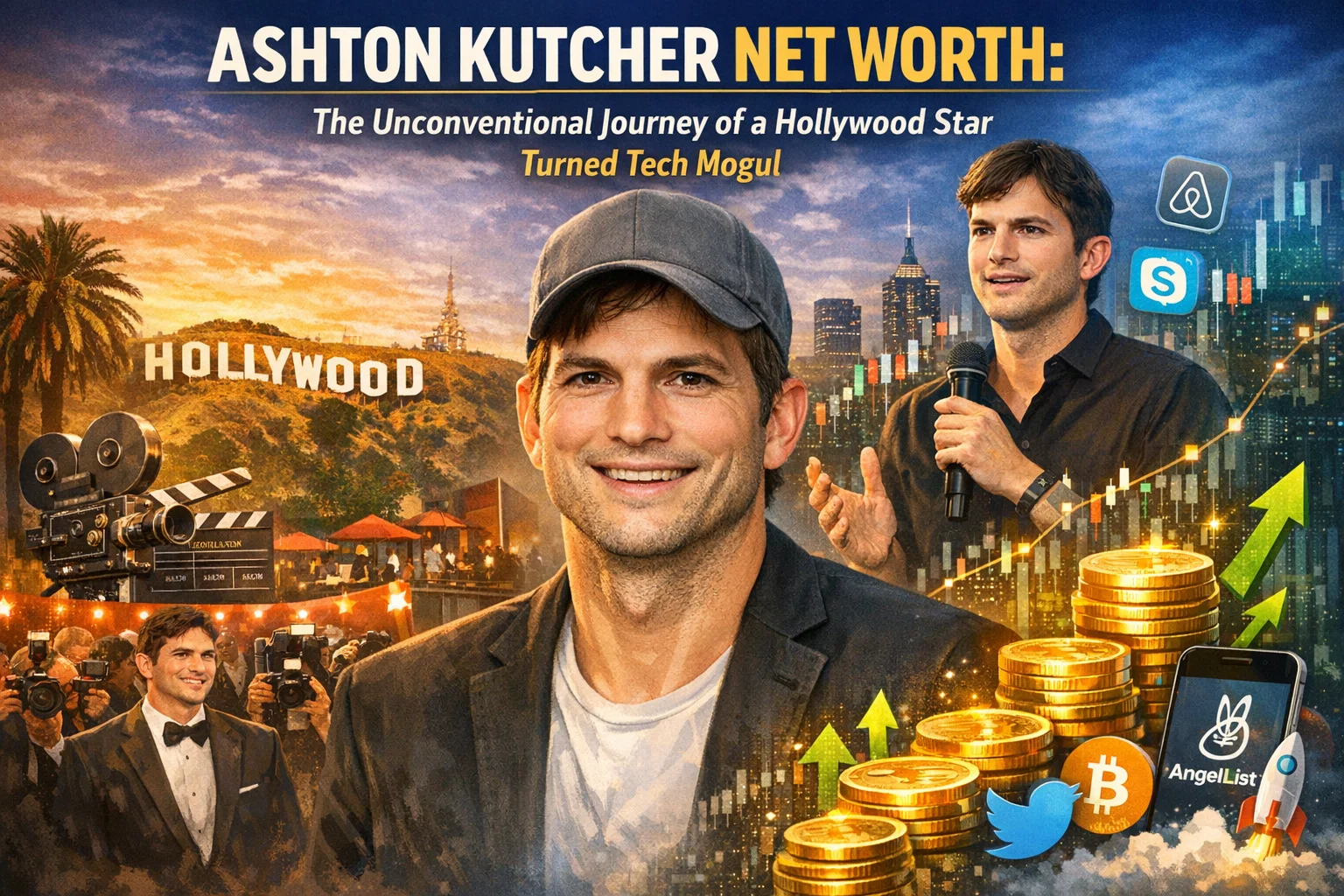
Ashton Kutcher Net Worth: When you hear the name Ashton Kutcher, a flurry of images might come to mind: the lovably dim-witted Kelso from That ’70s Show, the heartthrob from a string of early 2000s rom-coms, or perhaps the man who was once married to Demi Moore. For a long time, the public narrative framed him as a talented, but perhaps fortunate, Hollywood pretty boy. But that story is not just outdated—it’s spectacularly wrong. The true tale of Ashton Kutcher’s net worth is a masterclass in reinvention, intellectual curiosity, and strategic risk-taking. It’s a journey from a biochemical engineering student in Iowa to a Hollywood A-lister, and finally, to one of the most astute and influential technology investors in Silicon Valley. His financial portfolio is a testament to a mind that saw potential where others saw passing fads, building a fortune that dwarfs what he ever earned from acting paychecks alone. So, what exactly is the Ashton Kutcher net worth, and how did he assemble it? The answer is a fascinating blend of Hollywood earnings, prescient venture capital, and a philosophy of betting on the future.
The Ashton Kutcher net worth, estimated to be in the range of $200 to $250 million, is not a static number in a bank account. It’s a dynamic ecosystem of assets, equity stakes, and ongoing revenue streams. While his acting and modeling career provided the initial capital and platform, it is his work off-screen with his venture capital firms, A-Grade Investments and Sound Ventures, that forms the colossal foundation of his wealth. Kutcher quietly transformed himself from an actor playing Steve Jobs on screen to a real-world business visionary, investing in the infrastructure of the 21st century. This article will dissect every facet of his wealth accumulation, from his first Hollywood paydays to his multi-million dollar exits in tech unicorns, proving that the Ashton Kutcher net worth is a story of calculated intelligence, not just celebrity luck.
The Early Foundations: From Iowa to Hollywood Paydays
Ashton Kutcher’s journey to wealth began far from the glitter of Hollywood. Growing up in Cedar Rapids, Iowa, his childhood was marked by a strong work ethic instilled by his factory worker father and a profound personal challenge when his twin brother, Michael, was born with cerebral palsy. This early experience with adversity and medical costs seeded a deep understanding of life’s fragility and the importance of financial stability. Initially, Kutcher pursued a pragmatic path, enrolling at the University of Iowa for biochemical engineering, with dreams of someday finding a cure for his brother’s condition. To pay for tuition, he took on jobs like sweeping cereal dust at a General Mills plant—an experience he credits with motivating him to seek a different future.
His foray into entertainment was almost accidental. On a dare, he entered the “Fresh Faces of Iowa” modeling contest and won, which led to a move to New York and a contract with Next modeling agency. This success gave him the confidence and funds to try acting. He moved to Los Angeles, and in 1998, landed the role that would change his life: Michael Kelso on That ’70s Show. The show was an instant hit, running for eight seasons and becoming a cultural touchstone for a generation. While the exact salary for the young cast started modestly, by the later seasons, Kutcher was reportedly earning $150,000 to $200,000 per episode. This steady, substantial income for nearly a decade provided the crucial initial capital—the “seed funding,” in tech terms—that would later fuel his investment ambitions. It was his first major step in building the Ashton Kutcher net worth, proving he could excel in a competitive creative industry.
The Leading Man Phase: Movie Salaries and Production Ventures
As That ’70s Show solidified his fame, Hollywood quickly typecast Ashton Kutcher as the go-to guy for romantic comedies and lighthearted roles. He starred in a string of commercially successful films throughout the 2000s, including Dude, Where’s My Car?, Just Married, The Butterfly Effect, Guess Who, and What Happens in Vegas. While these films received mixed critical reviews, they were undeniable box office draws. At his peak as a leading man, Kutcher was commanding salaries in the range of $7 to $10 million per film. This period significantly inflated the Ashton Kutcher net worth, transforming him from a TV star to a bona fide movie star with global recognition.
However, Kutcher was already thinking beyond the paycheck. He founded his own production company, Katalyst Films, in 2000 with partner Jason Goldberg. Katalyst was behind several successful television projects, most notably the MTV phenomenon Punk’d, which Kutcher created, produced, and often hosted. Punk’d was a massive hit, defining a genre of celebrity prank shows and generating lucrative syndication rights. Katalyst also produced shows like Beauty and the Geek and The Real Wedding Crashers. This move into production was critical. It shifted Kutcher from being just talent-for-hire to an owner of intellectual property. The profits from these shows, especially Punk’d, created a more scalable and durable income stream than acting alone, demonstrating his early business acumen and adding a substantial layer to his growing financial empire.
The Pivot Point: From Actor to Investor
Beneath the Hollywood persona, Ashton Kutcher possessed a keen, analytical mind. He was an early adopter of technology, spending hours online in the late 90s and early 2000s. He saw the internet not just as a tool for entertainment, but as a fundamental reshaping of human connection and commerce. The pivotal moment came in 2009 when he was invited to co-host a CNN Twitter broadcast. Immersed in the tech world, he began meeting entrepreneurs and recognizing the seismic shifts happening in Silicon Valley. He realized the capital he had accumulated from acting could be deployed not just for luxury, but as fuel for innovation. This marked the conscious, decisive turn where the trajectory of the Ashton Kutcher net worth shifted from linear growth to exponential potential.
His first forays were personal angel investments. In 2009, he invested in Skype, the video calling platform, just two years before Microsoft acquired it for $8.5 billion. His stake, reportedly around $1 million, doubled in value upon the acquisition. This early win was not mere luck; it was a validation of his thesis. He saw Skype as a tool that could make global communication frictionless—a bet on connectivity. Around the same time, he made a now-legendary investment in Foursquare, then a blazing-hot location-based social network. While Foursquare’s trajectory later pivoted, this investment cemented Kutcher’s reputation as a celebrity who wasn’t just slapping his name on products, but was genuinely engaged in the tech ecosystem. He was building a portfolio and, more importantly, an education.
Building A-Grade: The Venture Capital Powerhouse
To systematize his investing, Ashton Kutcher teamed up with veteran talent manager Guy Oseary (who manages Madonna and U2) and billionaire investor Ron Burkle in 2010 to found A-Grade Investments. The premise was simple but powerful: leverage Kutcher’s celebrity for deal flow and public awareness, Oseary’s extensive network and business savvy, and Burkle’s deep financial resources and experience. The trio started with a $30 million fund, with their own capital. A-Grade was not a typical VC firm chasing every trend; it was highly focused, making early-stage bets on consumer-facing technology companies that were reshaping everyday life. The performance of this fund would become the single most important factor in the Ashton Kutcher net worth.
A-Grade’s investment strategy was brilliant in its clarity. Kutcher famously stated they looked for companies that solved “simple problems” with elegant technology. They invested in the series A or B rounds of companies that are now household names. Their most famous, and most lucrative, investment was in Uber. A-Grade invested $500,000 in the ride-hailing company’s 2011 Series B round. That stake grew to be worth an estimated $100 million at Uber’s IPO, a return of roughly 20,000%. Similarly, they invested early in Airbnb, another company that defined the “sharing economy.” A $1 million investment reportedly grew to over $100 million at IPO. These two bets alone transformed the Ashton Kutcher net worth from that of a very successful actor to that of a top-tier investor.
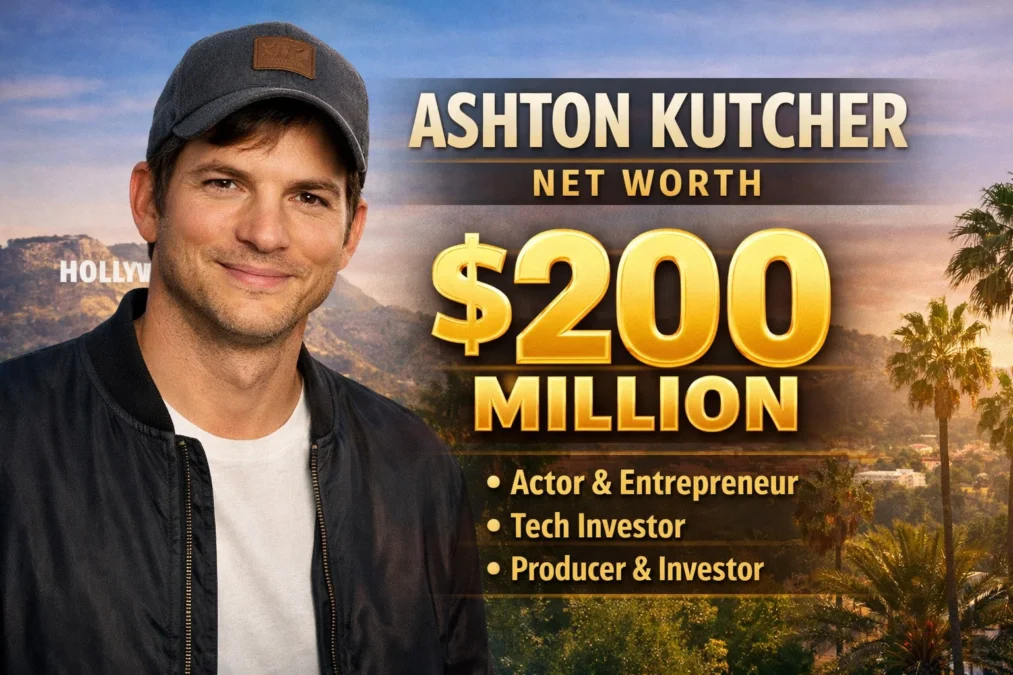
Table: Key A-Grade Investments & Impact
| Company | Sector | Estimated Return | Contribution to Net Worth |
|---|---|---|---|
| Uber | Ride-Sharing | ~20,000% (on $500k) | Massive, core asset |
| Airbnb | Hospitality/Travel | ~10,000% (on $1M) | Massive, core asset |
| Spotify | Music Streaming | Significant multiple | Major, liquid asset |
| Skype | Communication | 2x (pre-A-Grade) | Early validation win |
| Shazam | Music Recognition | Solid return (acquired by Apple) | Substantial |
Sound Ventures: Institutionalizing Success
Following the monumental success of A-Grade, Kutcher and Oseary launched Sound Ventures in 2015. This marked an evolution from a friends-and-family style fund to a more institutional, traditional venture capital firm. Sound Ventures raised hundreds of millions of dollars from outside limited partners, including other institutions and wealthy individuals. This move allowed them to write bigger checks and participate in larger funding rounds, further scaling their impact. The Ashton Kutcher net worth is now intrinsically linked to the performance of Sound Ventures’ diverse portfolio, which extends beyond consumer apps into frontier technologies like artificial intelligence, cybersecurity, and space.
Sound Ventures’ portfolio reads like a “who’s who” of modern tech. They have invested in companies like Robinhood (fintech), Affirm (fintech), Warbler Pincus (not applicable), Neuralink (neurotechnology), SpinLaunch (aerospace), and OpenAI (artificial intelligence). Kutcher has been particularly vocal about AI, calling it the “next, next big thing” and emphasizing both its transformative potential and its risks. His ability to pivot the fund’s focus to these cutting-edge sectors shows a relentless forward-looking mindset. The management fees and carried interest (the share of profits the fund managers take) from Sound Ventures’ growing assets under management provide a massive, steady, and sophisticated revenue stream that far outpaces any residual acting income.
Ongoing Hollywood Income and Lifestyle Assets
While investing is the engine of his wealth, Ashton Kutcher has never fully left Hollywood. His acting career, though more selective, continues to contribute. He returned to his iconic role in the Netflix sequel series That ’90s Show for a guest appearance, and he starred in the popular Netflix comedy The Ranch for several seasons, which likely paid a high premium given his star power and the show’s success on the platform. Furthermore, his early work, especially That ’70s Show and his hit films, continue to generate residuals and syndication royalties. These are “annuity-style” payments that provide a low-effort, consistent cash flow, which can be strategically redeployed into new investments.
With great wealth comes a notable lifestyle, and Kutcher’s assets reflect his success. He and his wife, actress Mila Kunis, own a stunning portfolio of real estate. They purchased a $10.2 million home in Beverly Hills in 2014 and later embarked on a lengthy, ambitious renovation. They also own a sprawling ranch-style property and have invested in other holdings. However, compared to some celebrities, Kutcher’s public spending has been relatively measured. He is known for pragmatic purchases rather than extravagant flaunting. A notable exception is his passion for automotive and aviation technology; he has owned several Tesla vehicles (an investment aligned with his tech philosophy) and is a licensed pilot. These assets are a fraction of his net worth but symbolize the freedom and future-oriented thinking that his financial success affords.
Philanthropy and Impact Investing
The story of the Ashton Kutcher net worth is incomplete without discussing how he uses it for impact. His brother Michael’s condition profoundly shaped his worldview. In 2010, he and Demi Moore founded the DNA Foundation, later renamed Thorn: Digital Defenders of Children. After their divorce, Kutcher doubled down on Thorn, which builds technology to combat child sexual exploitation and trafficking online. He isn’t just a figurehead; he is deeply involved in product development, even testifying before Congress about the issue. Thorn’s tools, like Spotlight, have helped identify thousands of victims and offenders. This work represents a significant allocation of his time, resources, and influence.
Kutcher’s philanthropy is strategic, mirroring his investment approach. He uses his tech network and know-how to build scalable solutions to social problems. Furthermore, his investment philosophy often intersects with impact. By backing companies like Uber and Airbnb, he invested in the “sharing economy,” which he believed could create more efficient use of resources and new income opportunities for people. His recent focus on AI and biotech through Sound Ventures also hints at investments that could have profound positive societal impacts. For Kutcher, wealth building and world-building are not mutually exclusive; the former enables the latter in a direct, applied manner.
Market Volatility and the Real Value of Net Worth
It is crucial to understand that an estimated Ashton Kutcher net worth of $200-$250 million is not like cash in a checking account. The vast majority of this wealth is illiquid equity—ownership stakes in private companies like those in the Sound Ventures portfolio. The value of these stakes is based on the last funding round valuation or an estimated market value. They can fluctuate wildly. For example, during tech market downturns or if a major holding like Uber sees its public stock price drop, the theoretical value of his net worth can contract significantly. This illiquidity and volatility are inherent to venture capital, the very field that built his fortune.
The Kutcher Blueprint: Lessons in Wealth Building
The ascent of the Ashton Kutcher net worth offers a powerful blueprint that extends beyond celebrity. The first lesson is the power of platform diversification. Kutcher never settled for being just an actor. He used his fame and income from acting as a launchpad to become a producer, then an angel investor, then a venture capital founder. Each layer created new, more scalable revenue streams and reduced his reliance on any single industry. He built a financial ecosystem, not just a salary. This is a crucial strategy for anyone: don’t rely on a single income source; use your skills and capital to build adjacent or entirely new avenues for growth.
The second, and perhaps most important, lesson is intellectual curiosity and thematic investing. Kutcher didn’t jump into tech because it was “hot.” He was genuinely engaged, spending years learning, meeting founders, and developing a thesis about connectivity and simple solutions. He invested in themes he understood and believed in: the sharing economy, democratized finance, and now, AI. He was early because he was paying attention. For everyday investors, this translates to investing in what you know and believe in for the long term, rather than chasing short-term hype. The Ashton Kutcher net worth story is ultimately about the compound returns of curiosity, conviction, and the courage to redefine oneself completely.
Conclusion
The Ashton Kutcher net worth is a modern financial fable that upends traditional expectations. It is the story of a man who refused to be defined by his first act. From the factories of Iowa and the soundstages of Hollywood to the boardrooms of Silicon Valley, Kutcher engineered his path with strategic precision. His initial fortune, earned through charisma and comedic timing, was merely the capital used to buy a front-row seat to the technological revolution. Through A-Grade Investments and Sound Ventures, he placed visionary bets on companies like Uber, Airbnb, and Spotify that would define a decade, transforming millions into hundreds of millions.
Today, the Ashton Kutcher net worth, estimated between $200 and $250 million, stands as a monument to this multifaceted journey. It represents more than money; it represents influence in the tech that shapes our daily lives, the capacity to fund groundbreaking philanthropic work through Thorn, and the freedom to pursue curiosity-driven projects. Kutcher’s legacy is no longer that of Kelso or a romantic lead, but of a sophisticated investor who demonstrated that the skills of storytelling and pattern recognition can translate from Hollywood scripts to startup pitch decks. His wealth is a dynamic, working engine for future innovation, proving that the most impressive fortunes are built not just by earning, but by seeing the future before it arrives and having the courage to build it.
Frequently Asked Questions (FAQ)
How did Ashton Kutcher make most of his money?
While many assume acting is the primary source, the majority of Ashton Kutcher’s net worth comes from his phenomenally successful venture capital investments. His early acting and production career provided the initial capital, estimated in the tens of millions. However, his strategic early bets through his firm A-Grade Investments in tech giants like Uber and Airbnb generated returns in the hundreds of millions of dollars, completely overshadowing his Hollywood earnings. His continued work with Sound Ventures manages and grows this fortune further.
What are Ashton Kutcher’s most successful investments?
Ashton Kutcher’s portfolio has several standout, legendary successes. The two most famous are Uber and Airbnb. A $500,000 investment in Uber’s early days grew to an estimated $100 million at its IPO. Similarly, a roughly $1 million stake in Airbnb also ballooned to over $100 million. Other highly successful investments include Spotify, Skype (which was an early, validating win), and Shazam. These companies form the core of the massive Ashton Kutcher net worth.
Does Ashton Kutcher still act?
Yes, but selectively. Ashton Kutcher no longer acts as his primary career, but he takes on roles that interest him. He notably starred in the Netflix series The Ranch for multiple seasons and made a guest appearance in the sequel series That ’90s Show. However, his time and focus are predominantly dedicated to running Sound Ventures, evaluating new tech investments, and his philanthropic work with Thorn. Acting is now a subsidiary interest, not his main economic engine.
How does Ashton Kutcher’s net worth compare to other actor-investors?
Ashton Kutcher’s net worth places him in an elite tier of actor-investors, arguably at the very top. While other celebrities like Jessica Alba (The Honest Company) and Ryan Reynolds (Maximum Effort marketing) have built successful business ventures, Kutcher’s approach is unique in its scale and focus on pure-play technology venture capital. His wealth, primarily derived from equity in multi-billion dollar companies, likely surpasses that of almost all his peers who mainly leverage their fame for consumer brands. He is compared more to figures like Jared Leto, who also is a serious tech investor, but Kutcher’s track record and fund size are particularly distinguished.
What is Sound Ventures, and how does it work?
Sound Ventures is the institutional venture capital firm founded by Ashton Kutcher and Guy Oseary after the success of their first fund, A-Grade Investments. It raises money from outside investors (limited partners) and uses that capital to make strategic investments in private technology companies, typically during early or growth stages. The firm earns money through management fees and a percentage of the profits (called “carried interest”) when these companies are sold or go public. The performance of Sound Ventures is now central to maintaining and growing the Ashton Kutcher net worth.
You may also read
The Rise of Dino Prižmić: Croatia’s Next Tennis Prodigy Taking the ATP by Storm