

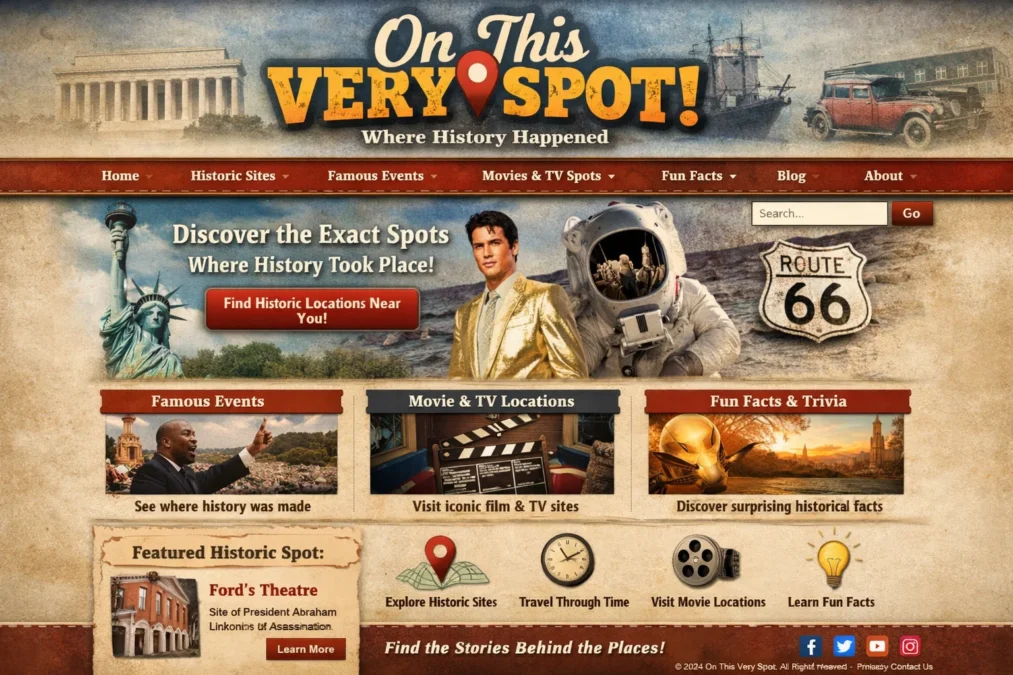
www.onthisveryspot.com Imagine standing on a bustling city street corner, surrounded by the sounds of traffic and the glass facades of modern skyscrapers. Now, imagine lifting your smartphone and pointing its camera at that scene. Through the screen, the contemporary world peels back like a layer, revealing that same corner a century ago: a dusty road with horse-drawn carriages, people in period clothing, and a historic building since demolished. This isn’t science fiction; it’s the evocative experience offered by www.onthisveryspot.com.
This innovative platform acts as a temporal bridge, connecting geographic coordinates with photographic archives from the past. At its core, www.onthisveryspot.com is a website and a concept dedicated to the “then and now” of our world. It allows users to explore, contribute to, and interact with a growing, crowdsourced database of historical photographs precisely geolocated on a digital map. The mission is simple yet profound: to make history tangible, contextual, and accessible to everyone, right where it happened. By anchoring the past to the precise longitude and latitude of the present, www.onthisveryspot.com transforms passive learning into an active discovery, turning every sidewalk, park, and plaza into a potential classroom without walls. It champions the idea that history isn’t just in textbooks; it’s literally under our feet, waiting to be uncovered through the lens of a photograph and the power of location.
Unpacking the Concept of Geolocated History
The genius of www.onthisveryspot.com lies in its elegant fusion of two powerful ideas: precise location and photographic evidence. We are spatial creatures; we understand our world through place. A story becomes infinitely more compelling when we can say, “This happened right here.” The platform leverages this instinct by using digital maps as its canvas. Every historical photo uploaded to www.onthisveryspot.com isn’t just stored in an album; it’s pinned to a specific point on the globe. This act of geolocation is what breathes life into the archive.
This approach moves us beyond traditional history browsing. Instead of searching through generic categories like “19th-century New York,” you can zoom into the very block where your apartment now stands. This creates a powerful, personal connection to the past that is often missing from broader historical narratives. The platform democratizes historical exploration, suggesting that every community, every street, has a story worth preserving and viewing. It shifts the focus from grand, sweeping narratives to the rich tapestry of micro-histories that make up our shared human experience. By tying images to coordinates, www.onthisveryspot.com ensures that the context of place is never lost, allowing the geography itself to become a character in the story of change and continuity.
The User Experience: From Casual Browsing to Deep Exploration
Engaging with www.onthisveryspot.com is an intuitive and often mesmerizing experience. Upon visiting the site, you are greeted by a familiar interactive map interface, reminiscent of services like Google Maps. The world is laid out before you, but scattered across its surface are countless markers, each one a wormhole to another time. You can immediately dive in by simply clicking and dragging the map to any location that piques your interest—your hometown, a famous landmark, or a random patch of countryside. Clusters of markers indicate areas rich with historical imagery.
Clicking on a marker opens a window displaying the historical photograph, along with crucial information: the approximate date, a descriptive caption, and often the contributor’s name. The interface is designed for discovery. You can browse photos in a list view for a specific area or simply lose yourself in the map. The true magic for many users, however, is the “slide” feature available on many entries. This tool allows you to directly compare the historical image with the current Google Street View, often with an adjustable slider that seamlessly blends the past into the present. This side-by-side, layer-upon-layer visualization is the heart of the www.onthisveryspot.com experience, making abstract historical change concretely visible. It’s one thing to read that a neighborhood has changed; it’s another to watch a cobblestone street morph into a six-lane highway with a flick of your finger.
The Power of the Crowd: A Community of Time Travelers
While the concept is powerful, the engine that truly drives www.onthisveryspot.com is its community. This is not a static archive curated solely by academics or institutions; it is a living, breathing, and growing repository fueled by user contributions. Anyone with a historical photograph, some knowledge of its location, and a free account can become a contributor. This crowdsourced model is revolutionary. It taps into the collective memory and attic treasures of thousands of people worldwide, amassing a collection of images that no single organization could ever compile.
The community aspect fosters a shared sense of stewardship over local history. A user might digitize their grandfather’s photo of a since-demolished factory, pin it to its former location on www.onthisveryspot.com, and in doing so, preserve a piece of industrial heritage for future generations. Other users can comment, provide additional context, or even upload related photos from different angles or eras. This collaborative verification and enrichment process creates a multi-perspective view of history. It turns the platform into a global conversation about place and memory, where a retired teacher in Edinburgh and a student in Tokyo can connect over the shared history of a specific spot, thanks to the common language of geolocated imagery.
The Technology Behind the Time Machine
A clever blend of accessible and sophisticated technologies underpins the seamless experience of www.onthisveryspot.com. At its foundation are the now-ubiquitous digital mapping APIs (Application Programming Interfaces), like those from Google and OpenStreetMap. These provide the detailed, interactive base maps onto which the historical content is layered. The platform’s own database stores the crucial metadata for each image: its GPS coordinates, date, description, and the digital image file itself.
A particularly ingenious piece of the puzzle is the process of accurately placing older photos. Contributors often have to play the role of historical detectives, using landmarks that still exist—the corner of a building, the curve of a river, the alignment of a road—to triangulate the exact spot where the photographer stood decades or even a century ago. The site’s comparison tools, which align historical photos with modern Street View, are a feat of digital visualization. They often require careful adjustment of perspective and scale to create a convincing “then and now” overlay. While not using complex augmented reality (AR) in the sense of live camera overlays (yet), www.onthisveryspot.com is fundamentally an AR concept in its purest form: augmenting our reality with contextual, historical data based on our location. It’s a powerful demonstration of how lightweight, web-based technologies can create deeply immersive experiences without requiring specialized hardware.
Educational Applications: Bringing History to Life in the Classroom and Beyond
Educators have been quick to recognize the immense potential of www.onthisveryspot.com as a pedagogical tool. It addresses a classic challenge in teaching history: making it relevant and immediate to students. Instead of staring at a small, out-of-context photo in a textbook, a class can use the platform to explore the history of their own school’s neighborhood. A lesson on World War II can be transformed by viewing photos of a local town square during a victory parade or seeing how a nearby factory shifted to wartime production.
The platform encourages critical thinking and primary source analysis. Students can be tasked with being historical investigators: comparing past and present scenes, hypothesizing about the reasons for changes, researching the stories behind the images, and even contributing their own finds from local archives. This active learning fosters a deeper connection to the subject matter. Furthermore, it teaches digital literacy and research skills in an engaging context. Field trips can be planned using the site as a guide, creating “history walks” where students use tablets or smartphones to view the layered past at various stops. www.onthisveryspot.com thus becomes more than a website; it’s a dynamic platform for project-based learning that breaks down the walls of the classroom and roots education in the tangible landscape.
Challenges and Considerations in Crowdsourced History
While the crowdsourced model is a strength, it also presents inherent challenges for a platform like www.onthisveryspot.com. The foremost concern is historical accuracy. When anyone can upload and pin a photo, how can users trust the information? A photo might be misdated, mislocated, or mis-captioned, either accidentally or intentionally. The platform relies heavily on its community for peer correction—users can comment with corrections or report inaccurate pins—but there is no formal, academic verification process for every submission.
Other issues include gaps in coverage. The density of historical photos on the map often correlates with areas that have affluent, tech-savvy, and historically record-keeping populations. This can lead to an overrepresentation of certain regions (such as North America and Western Europe) and an underrepresentation of others, inadvertently creating a digital map of historical privilege. Furthermore, the privacy and ethical considerations of posting old photos, especially those depicting identifiable individuals or sensitive moments, must be navigated. The platform operates on the goodwill and responsible judgment of its contributors, which, while often successful, is an imperfect system. These challenges highlight the balance the site must strike between being an open, inclusive archive and a trustworthy historical resource.
Comparative Landscape: How It Stacks Up Against Other History Tools
www.onthisveryspot.com occupies a unique niche, but it exists within a broader ecosystem of digital history tools. It’s useful to understand how it differs from and complements other resources.
| Platform/Tool | Primary Focus | Key Differentiator | How www.onthisveryspot.com Compares |
|---|---|---|---|
| Google Earth/Street View | Current geography & imagery | “Now” with some historical Street View | www.onthisveryspot.com is the dedicated “then,” often with older, user-submitted photos not in corporate archives. |
| Local Historical Societies | Deep, archival focus on a specific area | Physical artifacts, deep expertise | The website aggregates these local collections into a single, globally searchable map, giving them wider exposure. |
| Wikipedia | Encyclopedic knowledge on all topics | Text-based summaries with some media | www.onthisveryspot.com is media-first and location-centric; it’s about visual comparison at a coordinate, not reading an article. |
| Instagram / Flickr | General photo sharing & social networking | Social interaction, personal moments | This platform is purpose-built for historical comparison and geolocation, not social feeds. It’s thematic and contextual. |
| Academic Digital Archives | Scholarly research, high-resolution scans | Rigorous curation, metadata for experts | www.onthisveryspot.com is more accessible and exploratory, designed for public engagement over academic research. |
As one historian noted about the power of locative media, “The past is not just a time; it’s a place. Tools that reconnect events to geography restore a vital dimension to our understanding.” www.onthisveryspot.com excels in this reconnection, offering a more specialized and visually comparative experience than broader encyclopedias or social networks, while being more accessible and global than most local or academic archives.
The Future of Augmented Memory and Locative Media
The trajectory of www.onthisveryspot.com points toward exciting possibilities in the realm of augmented reality (AR) and locative media. The logical evolution is a dedicated mobile app that uses a smartphone’s camera and GPS in real-time. Imagine walking down a street, holding up your phone, and seeing historical photographs, labels, or even short videos overlay directly onto the live view of the buildings in front of you. This true AR implementation would make the time-travel experience completely seamless and immersive.
Future iterations could incorporate more media layers beyond static photos. Imagine audio clips of historical interviews from a location, 3D models of demolished buildings that you can “place” in the environment, or curated audio narrations that play as you move through a historic district. Integration with other data sets—census records, newspaper archives, architectural plans—could allow users to drill down from a photo into a rich network of related information, all anchored to that one spot. The potential for layered storytelling is vast. www.onthisveryspot.com has laid the essential groundwork by proving the public’s appetite for location-based history. Its future likely involves becoming an even more interactive and multi-sensory portal, further blurring the lines between past and present as we navigate our physical world.
How You Can Contribute to the Global Historical Layer
Becoming part of the www.onthisveryspot.com project is a rewarding way to preserve history. The process is straightforward. First, source your historical photos. These can be scans from your personal family albums, digitized images from local library archives (with permission, if required), or even old postcards. The key is that you need to know where the photo was taken. Next, create a free account on the website. Using the contribution tools, you upload the image file and then embark on the detective work of placing it on the map.
This placement is the most crucial step. Use the comparison tool to line up historical features with the modern Street View. Is that distinctive chimney still there? Has the road layout changed? Take your time to be as accurate as possible. Then, add all the information you know: an approximate date (even just a decade helps), a descriptive caption explaining what the photo shows, and any relevant source or credit. By contributing, you’re not just uploading a file; you’re rescuing a moment from oblivion and pinning it back onto the world for others to discover. You become a curator of your corner of history, enriching the global tapestry of www.onthisveryspot.com for explorers everywhere.
The Enduring Allure of “Then and Now”
The profound success and appeal of www.onthisveryspot.com tap into a fundamental human fascination: the passage of time and its visible impact on our environment. The “then and now” trope is powerful because it visualizes change, continuity, and our own place in the long stream of history. It creates a poignant dialogue between what was and what is. A quote often attributed to Marcel Proust fits perfectly: “The real voyage of discovery consists not in seeking new landscapes, but in having new eyes.” This platform gives us those new eyes, allowing us to see the layers of history inscribed in our everyday landscapes.
This visual comparison does more than satisfy curiosity; it fosters a sense of perspective. Seeing a serene field where a bustling mall now stands, or a grand building where there is now an empty lot, prompts reflection on progress, loss, urban development, and memory. It cultivates a deeper appreciation for the places we often take for granted and can even inspire civic engagement in historic preservation. www.onthisveryspot.com formalizes this innate curiosity, providing the tools and the collective archive to satisfy our desire to look back and understand how our present came to be. It turns every user into a temporal flâneur, strolling through the streets of both now and then simultaneously.
Conclusion: The World as a Palimpsest
In the end, www.onthisveryspot.com reveals a simple, beautiful truth: our world is a palimpsest. A palimpsest is an ancient manuscript page on which the original text has been scraped away to make room for new writing, but where traces of the old words often remain, faintly visible beneath the surface. Our cities and landscapes are just like that. The old street grids, the foundations of long-gone buildings, the memories embedded in place—they are all still there, just hidden beneath the layer of the present.
This website provides the tool to see those faint traces. It is more than a digital archive; it is a philosophy of place, a community of memory-keepers, and a powerful educational instrument. By marrying the timeless human interest in photography with the modern magic of geolocation, www.onthisveryspot.com has created a timeless and urgently modern way to engage with history. It reminds us that every spot has a story, and with a click, we can begin to read it. The next time you find yourself waiting on a street corner, consider pulling out your phone and visiting www.onthisveryspot.com. You might just discover that the most fascinating journey isn’t to a new destination, but to a new time, right on this very spot.
Frequently Asked Questions About www.onthisveryspot.com
How accurate are the photo locations on www.onthisveryspot.com?
The accuracy can vary, as the platform relies on its community of users to place photos. Many contributors are meticulous, using surviving architectural features to pinpoint the exact spot where the historical photographer stood, leading to highly precise placements. However, some photos may be more generally placed in the correct area if specific landmarks are missing. The site’s tools, like the side-by-side comparison with Street View, aid in this process. It’s always good to view the placements as generally accurate and often incredibly precise, but they should be considered as informed estimates rather than survey-grade data.
Is it free to use and contribute to www.onthisveryspot.com?
Yes, absolutely. Both browsing the vast collection of geolocated historical photos and contributing your own images to www.onthisveryspot.com are completely free. The platform operates on a model of open access and shared cultural heritage. You only need to create a free account to upload photos. This commitment to accessibility is central to its mission of democratizing history and building a crowdsourced archive that anyone can explore and enrich without financial barriers.
What kind of photos can I upload to www.onthisveryspot.com?
The site welcomes a wide range of historical photographs, provided you own the rights to share them or they are in the public domain. Ideal contributions are clear images that show a specific location—street scenes, buildings, landscapes, landmarks. The older, the better! You should have a good idea of where and approximately when the photo was taken. Family photos in front of a known house, scans of old postcards, and images from local historical collections are all perfect. The key is the locatable content; a portrait taken in an unknown studio is less suitable than a photo of a recognizable public space.
Can I use images from www.onthisveryspot.com for my school project or publication?
This depends entirely on the copyright status of each image. www.onthisveryspot.com is a hosting platform; it does not own the copyright to the photos uploaded by its users. Each image will have its own copyright situation—some may be fully in the public domain, others may be owned by the contributor. You must check the information provided with each photo and, if necessary, contact the contributor directly for permission. The site facilitates historical discovery, but users are responsible for ensuring they comply with copyright law when repurposing images found on the platform.
How does www.onthisveryspot.com differ from just searching for old photos online?
The critical difference is geolocation. While you can find countless historical photos through a general web search, they are often detached from their specific geographical context. www.onthisveryspot.com solves this by tethering every image to a precise point on a map. This allows for systematic exploration by location and, most importantly, the direct visual comparison with the present-day view via tools like the slider. It transforms a scattered collection of old pictures into a coherent, explorable layer of history over the modern world, which is a fundamentally different and more immersive experience than simple image browsing.